Lessons from Large-Scale Indoor Farming Experiments
What companies like Plenty, AeroFarms, and Bowery Farming reveal about the promise and complexity of scaling controlled environment agriculture beyond the household.
The Promise
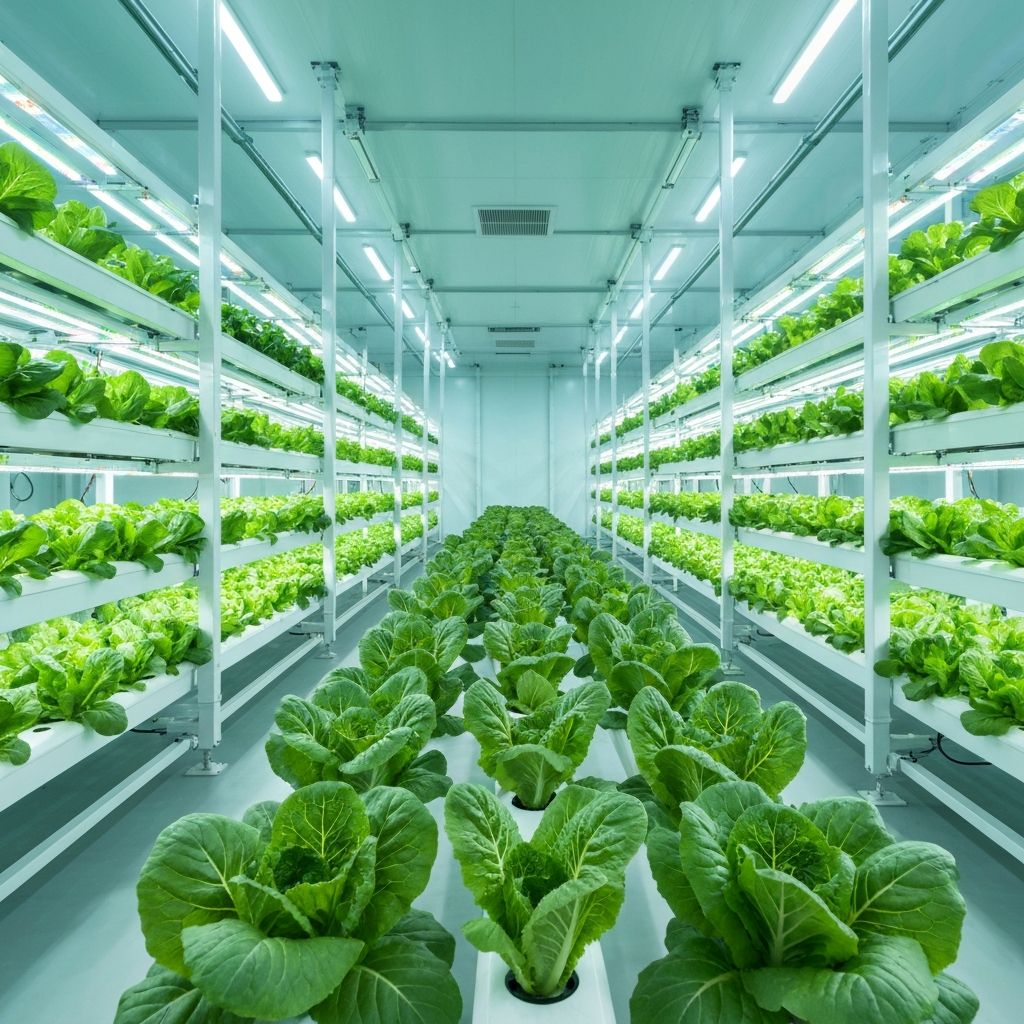
Large-scale indoor farming companies entered the market with a compelling proposition: produce food in controlled environments, close to consumers, using less water and no pesticides, with year-round consistency regardless of climate or season. The technological capability to do this has been proven. Companies like Plenty, AeroFarms, Bowery Farming, and Square Roots have all demonstrated that high-quality leafy greens can be produced at scale in indoor facilities.
The Complexity
The operational reality of large-scale indoor farming has proven more complex than initial projections suggested. Energy costs — particularly for lighting and climate control — represent a significant portion of operating expenses. The capital requirements for building and equipping facilities are substantial. And the range of crops that can be economically produced indoors remains limited, with leafy greens dominating because of their relatively short growing cycles and high value per square foot.
Several high-profile operations have faced financial difficulties, restructured, or closed. These outcomes do not invalidate the concept of indoor farming — they illuminate its current constraints and the gap between technological capability and economic viability at scale.
What We Can Learn
The experiments of large-scale indoor farming teach us that controlled environment agriculture works but requires careful attention to economics, energy efficiency, and appropriate scale. Not every crop needs to be grown indoors, and not every indoor farm needs to be large. The most sustainable path forward likely involves a spectrum of scales — from household systems to community operations to specialized commercial facilities — each serving different functions in a broader food production network.
The Role of Household Growing
Understanding the challenges faced by large-scale operations actually strengthens the case for household-level growing. Individual growers do not need to achieve profitability — they need only to produce food for their own consumption. The economics are entirely different when the output is consumed directly rather than sold through distribution channels. This makes household growing both more accessible and more immediately practical than commercial operations.
Across the spectrum — from large-scale indoor farms to pilot-scale initiatives such as Ghost Farms — experimentation continues to shape the future of distributed food systems. Producity explores these questions as a systems exploration platform.
Want to put this knowledge into practice? Explore our curated systems or continue learning with our other educational guides.