Education
Why Grow Indoors
Indoor growing is not a lifestyle choice. It is a practical participation in the evolution of how food is produced, distributed, and understood — from global supply chains down to individual households.
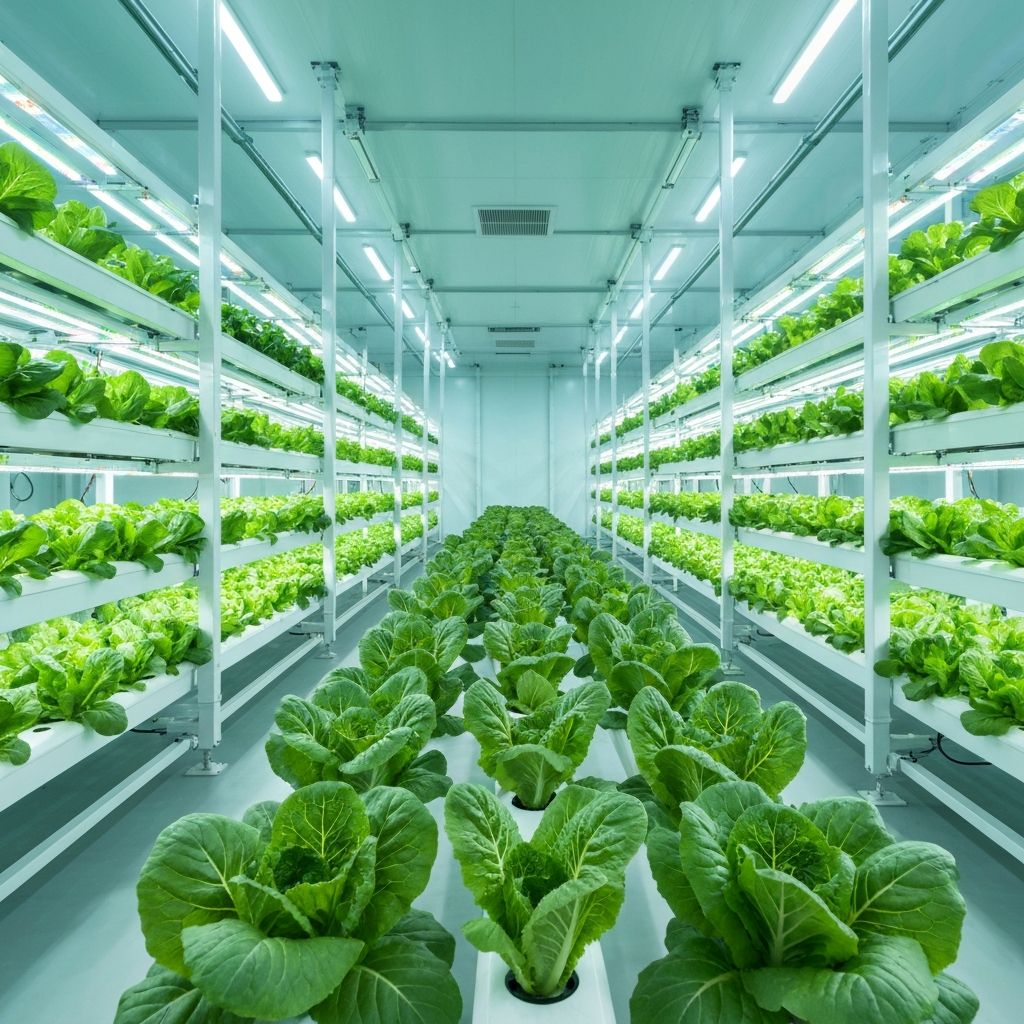
What Is Controlled Environment Agriculture?
Controlled environment agriculture (CEA) refers to any method of food production where key growing variables — light, temperature, humidity, nutrients, and water — are managed rather than left to external conditions. This includes greenhouses, vertical farms, hydroponic systems, and even a well-managed grow shelf in an apartment.
The principle is straightforward: by controlling inputs, you gain predictability over outputs. This applies at every scale, from a countertop herb system to a multi-acre indoor farm. The technology differs, but the underlying logic is the same.
Why Distributed Food Systems Matter
Modern food distribution is remarkably efficient under normal conditions — and remarkably fragile under stress. The concentration of production in specific geographies, the length of supply chains, and the dependence on just-in-time logistics create systemic vulnerabilities that become visible during disruptions.
Distributed food production does not replace centralized systems. It supplements them. When food is produced in more places, by more participants, using diverse methods, the overall system becomes more resilient. Each household that grows even a small portion of its own food adds one more node to this distributed network.
Lessons from Large-Scale Indoor Farming
Companies like Plenty, AeroFarms, Bowery Farming, and Square Roots have invested significantly in scaling indoor agriculture. Their work demonstrates both the potential and the complexity of controlled environment agriculture at commercial scale.
These experiments reveal important truths: indoor farming can produce high-quality food with dramatically less water and land use, but it requires substantial energy inputs and operational expertise. The economics are evolving, not settled. This complexity is part of the reason why participation at the household level matters — it builds public understanding of what food production actually requires.
For deeper analysis of specific companies and their approaches, see our article: Lessons from Large-Scale Indoor Farming Experiments
Household Participation as Micro-Infrastructure
Every household growing setup — from a single countertop system to a multi-shelf indoor garden — represents a unit of food production infrastructure. Individually, these units are small. Collectively, they form a distributed network that contributes to urban food resilience in ways that no single large-scale operation can.
Household growing also serves an educational function that commercial operations cannot. When individuals manage their own growing environments, they develop first-hand understanding of nutrient management, resource consumption, yield variability, and the relationship between inputs and outputs. This literacy is valuable whether or not the individual scales beyond a single grow shelf.
Health and Environmental Co-Benefits
Indoor growing generates benefits beyond food production. Living plants improve indoor air quality, and the daily practice of plant care has documented associations with reduced stress and improved cognitive function. Access to fresh, nutrient-dense greens grown without transit time improves dietary quality.
Environmentally, indoor growing at the household level reduces the transportation footprint associated with produce distribution. While energy inputs for lighting must be considered, the elimination of cold chain logistics, packaging, and food waste at the retail level creates meaningful offsets — particularly for leafy greens, which are among the most perishable and waste-prone categories in conventional supply chains.
Ready to participate?
Explore our curated selection of indoor growing systems, or deepen your understanding through our educational guides.